Placing an OEM or private label order from a Chinese factory is more straightforward than most first-time buyers expect. The process follows a predictable sequence: logo, packing, sampling, production and shipping. This guide walks each step for a kitchen storage product line, from first contact to goods at your warehouse.
Logo: Laser vs Silk-Screen
The first OEM decision is how your logo appears on the product. Two methods dominate kitchen storage products.
Laser engraving burns the logo into the steel surface. It is permanent, does not fade or peel, and works on any steel finish. The limitation is that laser engraving is monochrome: it creates a contrast effect by altering the surface texture, not by adding colour. Laser engraving costs $0.10 to $0.30 per unit depending on logo complexity.
Silk-screen printing applies ink to the surface. It supports full-colour logos and works on both steel and plastic surfaces. The limitation is durability: printed logos can fade, scratch or peel over time. Silk-screen printing costs $0.05 to $0.15 per unit for single-colour logos.
Stamped or embossed logos are pressed into the product during manufacturing. They are permanent and cost nothing extra, but require a custom mould ($500 to $2000 tooling cost). Stamping suits high-volume orders (5000+ pcs) where the tooling cost is amortised.
Send your logo as a vector file (AI, EPS or SVG) to the factory. They will provide a mockup showing the logo on the product before sampling.
Packing: Poly Bag, Colour Box, FNSKU
Packaging affects shipping cost, retail presentation and Amazon compliance. The three main options serve different sales channels.
Poly bag is the cheapest option. The product goes in a clear plastic bag with a printed header card. This suits online-only sales and wholesale distribution. Cost: $0.05 to $0.15 per unit.
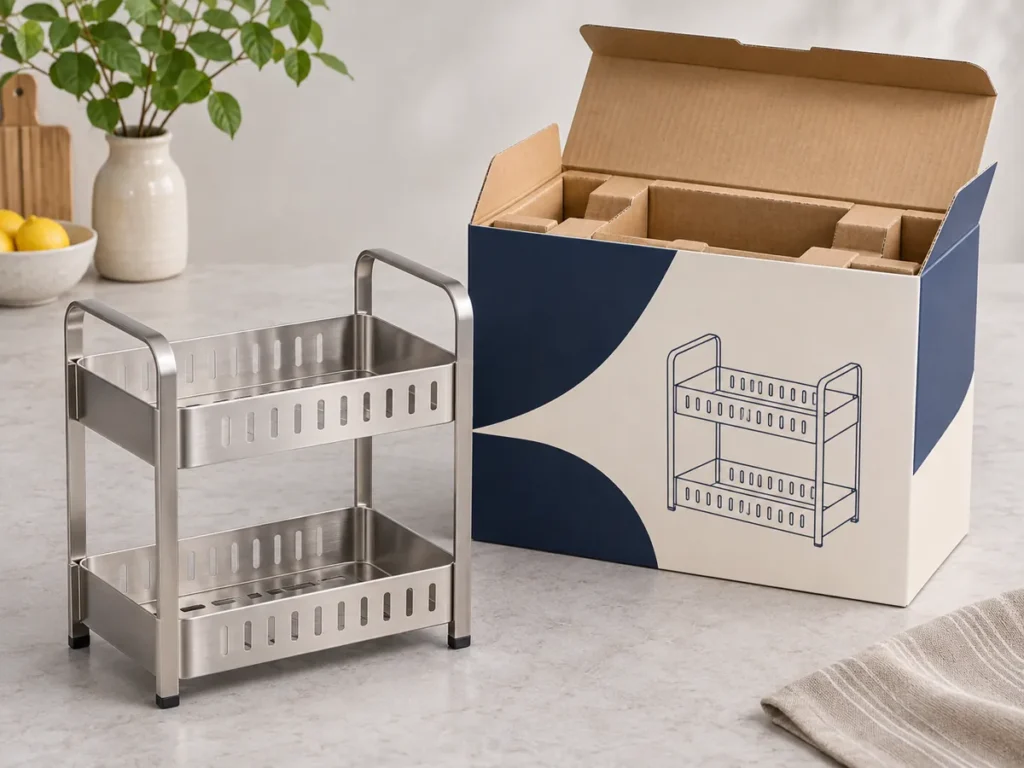
Colour box is a printed cardboard box with product photography. It adds perceived value and protects the product for retail shelving. Cost: $0.30 to $0.80 per unit depending on size and print quality.
FNSKU labelling is required for Amazon FBA. The FNSKU barcode identifies your product in Amazon’s system. Place it on the poly bag or box, not on the product. Include it in your artwork before sampling.
Master carton configuration affects shipping cost directly. Confirm the master carton dimensions and quantity per carton before the order. Ask the factory to optimise the packing for container fill.
MOQ, Sampling and Lead Time (to China Warehouse)
The timeline from order to delivery follows a predictable sequence. Understanding it helps you plan inventory.
Standard MOQ for existing designs is 200 to 500 pcs per SKU. Custom designs or colours require 500 to 1000 pcs minimum. Some factories accept lower MOQ for trial orders at a higher unit price.
Sampling takes 5 to 10 days from approval of the mockup. Sample cost is typically $20 to $50 per unit plus shipping. Many factories credit the sample cost against the bulk order. Request a sample before committing to production: it is the only way to verify quality.
Production lead time is 15 to 30 days from order confirmation and deposit. Complex custom products or large orders may take 30 to 45 days. Confirm the production schedule in writing before the deposit.
Sea freight adds 25 to 35 days from the Chinese port to most destinations. Air freight adds 3 to 7 days but costs 5 to 8 times more per unit. For a 40-foot container, sea freight costs $2000 to $4000 depending on destination.
Total timeline from first contact to goods at your warehouse: 8 to 12 weeks for standard products, 12 to 16 weeks for custom designs. Plan your inventory order 3 to 4 months before you need the goods.
Deposit, Production and Shipping Terms
Payment and shipping terms determine your cash flow and risk exposure.
Standard payment terms are 30% deposit with order confirmation and 70% balance before shipment. Some factories accept T/T (bank transfer), PayPal or Letter of Credit for larger orders. Avoid 100% upfront payment: it removes your leverage if quality issues arise.
Shipping terms: FOB (Free on Board) is the most common for B2B orders. The factory delivers goods to the Chinese port, and you handle international shipping. CIF (Cost, Insurance and Freight) includes shipping to your port but gives the factory control over the freight forwarder.
Quality inspection: request a pre-shipment inspection before paying the balance. Most factories allow third-party inspection (SGS, Bureau Veritas) at the buyer’s cost. This is the single most effective way to prevent quality disputes.

 AI concept illustration
